Fermentation temperature control…

fermHerewith the temperatures of the cellar and brew in this hot weather.  The kit says that the temperature should be 16-20°C.  In the days before I started it the mean temperature of the cellar was 16°C so I chose 17°C, since lower temperature gives more flavour.  The Sun then came out, and the cellar temperature slowly climbed (red line).  The variation in the cellar temperature is either the freezer switching on and off or the fan that keeps the humidity down.

You can see that the brew, which started at house room temperature, cooling down then the fermentation kicking off and the brew temperature rising again because of the respiration.  It appears to be levelling off now, and I am hoping for a cool spell.

Brew fridge next?

Sadlers Pinot Grigio Rosé

500D_2266

Another day, another wine.  I have wanted to do a rosé, so here we go.  Standard stuff, but there are DIRE warnings about oxidation, down to taking gravity readings through the bubbler hole using a tube.

When I bought the kit I was handed a nice new bottle of chitosan, as they had clearly had problems with the stuff in the kits.  Sure enough, when I opened the box, the “chitosan” inside was mouldy.  The kit included tartaric acid, bentosil must conditioner and grape skin tannin, but they just went in one after the other as per the instructions.  The only other thing to note is that after my assiduous 5 minutes of stirring I got an OG of 1080, which was lower than the lowest reading that they suggest in the instructions (1090-1082).  I don’t think I had too much water either.

DateSpecific GravityAlcohol Content
12th June 20141,0800%
8th July 201499611.1%

Testing the Elderflower Champagne

Bulging bottle
Bulging bottle

It has been two weeks since I bottled the elderflower champagne.  When it went in to the bottles there was absolutely no sign of any action at all with regards to fermentation.  But a couple of days ago I was chatting with the guy at May and Brett’s and he said I should take a look and release pressure if needed.  I am glad I did – the pressure was so high that the bottles were not really bottle shaped and were bulging out.  you can sort of see in the photo that the bottle no longer has the defined ridge for the label – and this is AFTER easing off the pressure.

I estimate the alcohol content of this to be about 3% (I forgot to do a gravity reading beforehand, so that is based on calculation only).  It is definitely drinkable, though very elderflowery (surprise), two weeks after being started, but I think that next time I will ferment in the bucket for longer and maybe try some commercial champagne yeast to see if it makes a difference.


Bottling and Testing Wine

The new chitosan had made a massive difference to the Sadlers Sav, so I racked it in to clean demijohns.  I then thought it would be good to bottle some up.  I duly did this, bottling the blend of the Sadlers Sav and Conniseur Pinot Gris.  At the same time I realised that the Rice and Raisin was not going to get drunk, sitting in the demijohn, and as it is supposed to be drunk relatively young, I bottled that as well.

The rice and raisin is OK, but has the homebrew tang that I don’t like “up front” before settling down a little on the palette.  I sort of quite like it, but I am not sure I would offer it to friends (though I did give a bottle to my home brewing sister-in-law, together with warnings!).

Elderflower Champagne?

Elder on the far right Elder on the far right[/caption]

I have not made elderflower champagne before, but a little bit of research suggested that it was pretty easy.  In the end I doubled up a recipe from the River Cottage forums, but all the ones I found looked pretty similar.  Here is the recipe I used metricised and doubled up:

9l hot water
1.62kg white sugar
7 heads of elderflowers
2 lemons, sliced thinly
30ml white wine vinegar

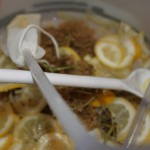
Dissolve sugar in water, and leave to get cold; add lemons, flowers and vinegar. Cover loosely with a tea towel and leave for 24 hours. Strain and bottle, try after a fortnight.

I saw absolutely no evidence of fermentation in the mixture AT ALL.  Maybe I put the elderflowers in when the water was too warm (28°C) but that seems a bit pessimistic since I found many examples of people saying that there never is any sign of fermentation.  This is natural yeast after all (I’d bought some champagne yeast before researching this).

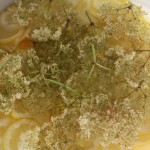
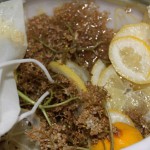
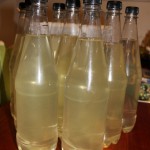
24 hours after mixing it up I bottled it, and you can see the result below.  It looks the right colour and I am very interested to see what happens over then next two weeks.  At least I know that my PET bottles won’t explode.